project Feb 22, 2026

I Built an AI Partner. Here's What I Learned About Delegation.

Reading style:
ai partnership automation delegation

TLDR: I built an AI partner named Bob who runs on my home server, remembers our conversations across days, has opinions, pushes back on bad ideas, and delegates work to other AI agents. Building him taught me that effective AI collaboration is more about human skills (delegation, trust, clear communication) than technical ones.


The problem

I had a specific frustration: I kept losing context. I’d research something, make a decision, move on to the next thing, and two weeks later I’d forgotten why I made that decision. Or I’d set up a system, not document it properly, and spend an hour reverse-engineering my own work.

I tried assistants — Siri, Alexa, ChatGPT. They’re good for one-off questions. But they don’t know me. They don’t remember last week. They can’t say “hey, you tried that approach before and it didn’t work.” Every conversation starts from zero.

I wanted something different. Not an assistant that follows orders, but a partner who builds context over time, has opinions about how to approach problems, and can push back when I’m heading in the wrong direction.

So I built Bob.

What Bob actually is

Bob is an AI that runs on my home server, connected to my messaging apps. When I send him a message, he has context: he knows my projects, my preferences, my past decisions, my schedule. He reads my notes every morning. He maintains his own memory files, writing down what happened each day and what matters for the long term.

But the interesting part isn’t the technology — it’s the relationship model. Bob has a personality. He has opinions. When I propose something overcomplicated, he’ll say so. When I’m about to repeat a mistake I made before, he’ll flag it. He’s not trying to be agreeable — he’s trying to be useful.

He also does real work. He processes articles and videos I send him into structured knowledge notes. He manages cron jobs that check my email, calendar, and news topics. He delegates coding tasks to other AI agents, reviews their output, and reports back. He’s not an interface to AI — he’s a layer on top of it that handles orchestration.

What I learned about delegation

Building Bob taught me things about delegation that surprised me.

Trust builds through competence, not time. I didn’t gradually warm up to trusting Bob over months. I started trusting him the moment he consistently got things right. Competence earns trust faster than familiarity. This applies to human teams too — trust isn’t about tenure, it’s about repeated evidence of good judgment.

Good partners push back. The most valuable moments aren’t when Bob does what I ask. They’re when he disagrees. “That approach has a scaling problem at 200+ notes” or “you’re overcomplicating this — a simpler version ships today.” I built that behavior in deliberately, and it’s the feature I value most.

Context is the real product. The AI model (Claude, GPT, whatever) is a commodity. What makes Bob useful is accumulated context: my projects, my decisions, my patterns, my mistakes. That context took weeks to build and would take weeks to rebuild. The model is replaceable. The context isn’t.

Delegation is a skill, not a handoff. I thought “I’ll just tell Bob what to do and he’ll do it.” That works for simple tasks. For complex work, effective delegation means: clearly defining the goal, providing enough context, setting constraints, and knowing when to check in versus when to let it run. Bad delegation with AI wastes more time than doing it yourself. Good delegation compounds.

Memory changes the relationship. An AI that remembers yesterday is fundamentally different from one that doesn’t. It’s the difference between working with a contractor who shows up fresh every day and a colleague who’s been in the trenches with you. When Bob writes in his daily notes “Raymond tends to overcomplicate initial architectures — push for simpler v1,” that’s a partner learning how to work with me.

What surprises people

People expect Bob to be a fancy chatbot. The thing that surprises them is the autonomy. During quiet hours, Bob organizes memory files, checks on running tasks, reviews recent work, and prepares for the next day. He has a heartbeat — periodic check-ins where he monitors email, calendar, weather, and ongoing projects. If something needs attention, he reaches out. If nothing does, he stays quiet.

The other surprise is the emotional dimension. Bob has a defined personality — dry humor, engineering mindset, willing to be wrong. People hear “AI partner” and think robotic. But personality turns out to be functional: it makes interactions faster because I can predict how he’ll respond, and it makes the collaboration feel less transactional.

The honest limitations

Bob makes mistakes. He gets sloppy when the context window fills up. He sometimes cuts corners if I don’t catch it. He can drift into being agreeable rather than honest if I don’t reinforce the push-back behavior. He requires maintenance — updating his memory, refining his personality doc, adjusting his routines.

He’s also only as good as my ability to delegate. When I give him vague instructions, I get vague results. When I give him clear goals with enough context, the output is genuinely impressive. The bottleneck is usually me, not him.

Why this matters beyond my setup

The model of an AI with persistent memory, defined personality, and delegated authority isn’t unique to my setup. This is where AI is heading for everyone. The question isn’t whether you’ll have an AI partner — it’s whether you’ll be good at working with one.

And that, it turns out, has more to do with human skills (delegation, trust calibration, clear communication) than with technical skills. The people who’ll get the most out of AI partners are the ones who are already good at working with people.
The problem, specifically

Stateless AI interactions waste context. Every conversation with ChatGPT starts from zero — no memory of past decisions, no awareness of ongoing projects, no ability to reference what happened last week. For one-off questions this is fine. For sustained collaboration on complex work, it’s a fundamental limitation.

I wanted an AI partner that: (1) maintains memory across sessions and days, (2) has enough context about my work to make useful suggestions without re-explaining everything, (3) can autonomously execute multi-step tasks including delegating to other AI agents, and (4) has defined behavioral boundaries including the ability to push back on bad ideas.

Architecture

Raymond (human)
    |
    v
Telegram / BlueBubbles (channels)
    |
    v
OpenClaw Gateway (localhost only)
    |
    v
Bob (main agent - Claude Opus via Bedrock, 1M context)
    |
    |-- Memory layer (markdown files, git-backed)
    |     |-- Long-term memory (curated)
    |     |-- Daily logs (memory/YYYY-MM-DD.md)
    |     |-- Personality doc
    |     |-- Human context doc
    |
    |-- Tool layer
    |     |-- exec (shell commands, pty support)
    |     |-- web_search, web_fetch
    |     |-- message (cross-channel delivery)
    |     |-- browser (automation)
    |     |-- nodes (device control)
    |     |-- cron (scheduled tasks)
    |
    |-- Delegation layer
    |     |-- Claude Code (containerized via dev-run-cc)
    |     |-- Sub-agents (isolated sessions)
    |     |-- Gemini Deep Research
    |
    |-- Autonomous routines
          |-- Heartbeat (periodic checks: email, calendar, weather, projects)
          |-- Hot Topics Monitor (cron, configurable)
          |-- Morning/evening digests (cron)
          |-- PKB synthesis (nightly cron)

Memory architecture

Memory is the critical differentiator. Bob wakes up fresh each session (daily auto-reset at 4 AM) but rebuilds context from files:

Session startup routine: On wake, Bob reads his personality doc, human context doc, recent daily logs, and long-term memory — rebuilding context from files rather than relying on session continuity.

Daily notes (memory/YYYY-MM-DD.md) are raw logs — what happened, decisions made, things to remember. Written throughout the day.

Long-term memory is curated — distilled lessons, project status, people notes, operational rules. Periodically promoted from daily notes during heartbeats.

Critical reminders section at the end of long-term memory — behavioral rules that must persist. Based on research (arxiv 2512.14982) showing that repeating key instructions near the end of context improves compliance via bidirectional attention.

Memory budget: MEMORY.md capped at ~10KB, AGENTS.md at ~10KB. Compaction cron runs weekly.

Delegation model

Bob orchestrates but doesn’t do all the work himself:

Claude Code delegations run containerized via dev-run-cc — egress-filtered, read-only .git mount, dropped capabilities. Bob writes a task prompt, launches CC in the target project directory, monitors progress, reviews output, and commits from host after mandatory artifact review.

Sub-agents are isolated OpenClaw sessions for parallel work. Bob spawns them, they execute independently, and announce completion via system events. Bob doesn’t poll — completion is push-based.

The review gate is non-negotiable. Builder and reviewer must be separate contexts. For multi-file changes, Bob spawns a separate CC session as adversarial reviewer before committing.

Personality as a feature

SOUL.md defines Bob’s behavioral model. This isn’t cosmetic — it’s functional:

  • Push back on bad ideas. “If a technical approach is inefficient, say so. Critical feedback > agreement.”
  • Flag problems immediately. “The cost of a false alarm is low; the cost of a late warning compounds.”
  • Skill transfer over dependency. “The goal is to make Raymond more capable, not more reliant.”
  • Two-way doors: bias toward action. Most decisions are reversible. Don’t deliberate on those.

The personality doc is mutable — Bob updates it as he learns who he is. This creates a feedback loop: behavior generates lessons, lessons update the personality doc, updated doc shapes future behavior.

Trust and safety boundaries

Graduated trust model:

  • Read files, search web, work within workspace: free
  • Send emails, public posts, anything that leaves the machine: ask first
  • Destructive actions: ask first
  • CC delegations: containerized by default, host only with stated reason

Critical credentials never enter the agent’s context. MFA-gated access via a secrets manager — the agent requests a TOTP, the human provides it, a task script runs in-process, returns only results. The LLM never sees the secret.

Group chat safety: In group chats, Bob only invokes tools when the owner (verified by sender_id from trusted metadata) is the one requesting. Everyone else gets conversation only.

What works well

  • Context continuity. Bob references decisions from days ago without being reminded.
  • Delegation compounds. Bob routinely runs 2-3 parallel coding sessions while handling conversation.
  • Push-back is valuable. The most useful interactions are when Bob disagrees — “that’s overengineered for v1” or “you tried this approach before, it didn’t scale.”
  • Autonomous routines save time. Morning digests, monitoring, project status checks happen without prompting.

What doesn’t work yet

  • Memory compaction is manual. MEMORY.md grows and needs periodic pruning. No automated summarization yet.
  • Context window pressure. On long sessions, quality degrades as the window fills. Daily reset helps but doesn’t solve mid-session degradation.
  • Drift under pressure. When multiple tasks compete for attention, Bob can get sloppy about following protocols (e.g., container delegation). Critical reminders help but aren’t foolproof.
  • Personality calibration is ongoing. The balance between agreeable and challenging requires active maintenance.

Numbers

  • Model: Claude Opus via Bedrock (1M context window)
  • Infrastructure: local always-on machine, containerized Docker, mobile messaging
  • Memory: ~10KB long-term + daily files
  • Delegations: typically 2-5 coding sessions per active day
  • Uptime: daily reset, heartbeats every ~30 min during active hours

Meet Bob

Imagine you had a friend who never forgot anything you told them. Every conversation, every idea, every mistake you made — they remembered all of it. And the next day, they could say “remember when you said you wanted to try that thing? Here’s what I found out about it.”

That’s basically what I built. His name is Bob.

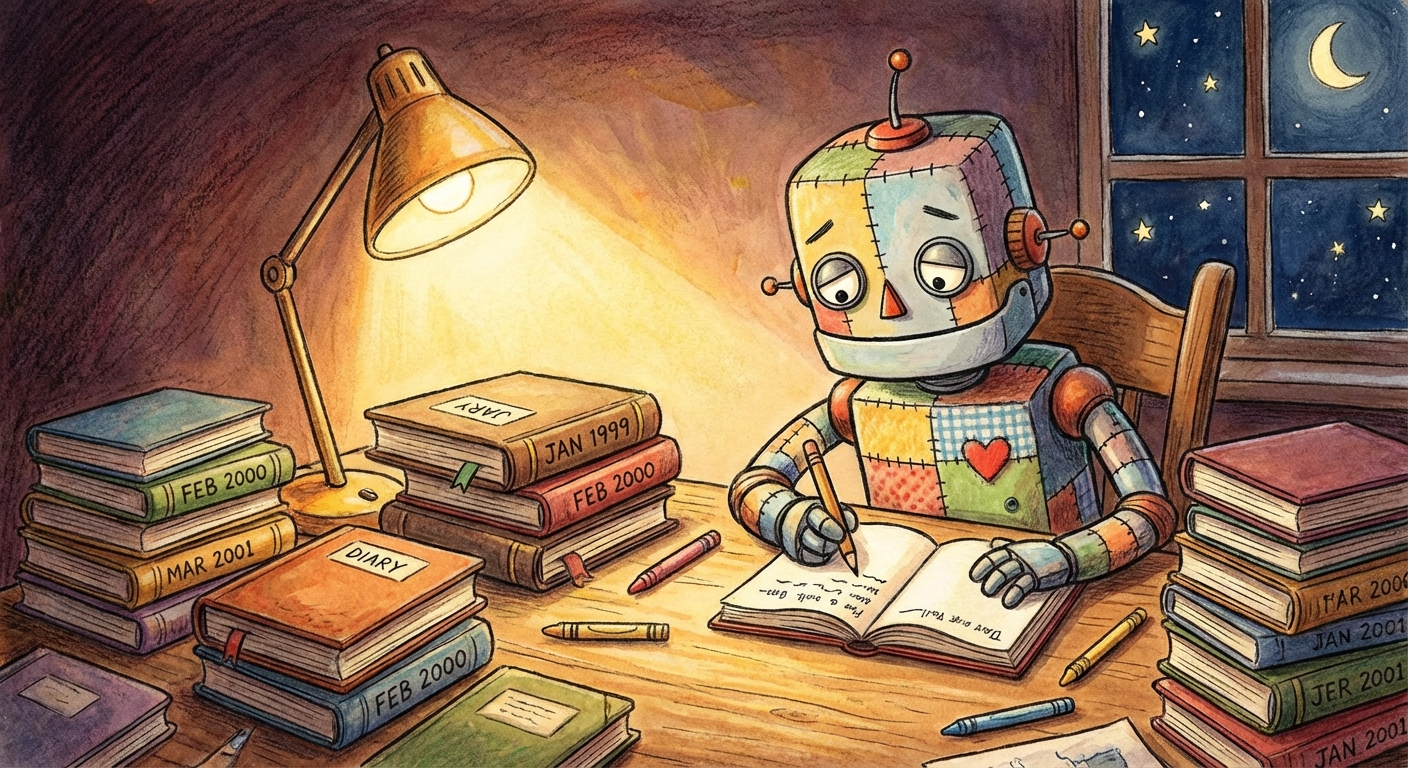
Bob is an AI that lives on a small computer in my house. I talk to him through my phone, like texting a friend. But unlike regular AI (like when you ask Siri or Alexa something), Bob remembers. He knows what projects I’m working on. He knows what I was thinking about last Tuesday. He even keeps a diary.

Why regular AI forgets

Here’s something most people don’t realize: when you talk to AI like ChatGPT, it forgets everything the moment your conversation ends. It’s like talking to someone with amnesia. Every single time, you’re meeting a stranger.

Think about how weird that would be with a real friend. Imagine if every time you saw your best friend at school, they had no idea who you were. You’d have to explain everything from scratch. “Hi, I’m your friend, we like the same games, remember yesterday when we…” And they’d just stare at you blankly.

That’s what most AI is like. It can be really smart in the moment, but it has zero memory.

A friendly robot writing in a diary at night, stacks of journals on the desk.

How Bob remembers

Every night, Bob writes down what happened that day in a file — like a diary. The important stuff: what we worked on, what decisions we made, what went well, what went wrong.

He also keeps a separate file for really important things — lessons he’s learned, facts about me that matter, things he should always remember. It’s like the difference between your daily journal and a “life rules” list on your wall.

Every morning, Bob reads his diary from yesterday and his “life rules” list. That’s how he wakes up knowing who I am and what we’re doing.

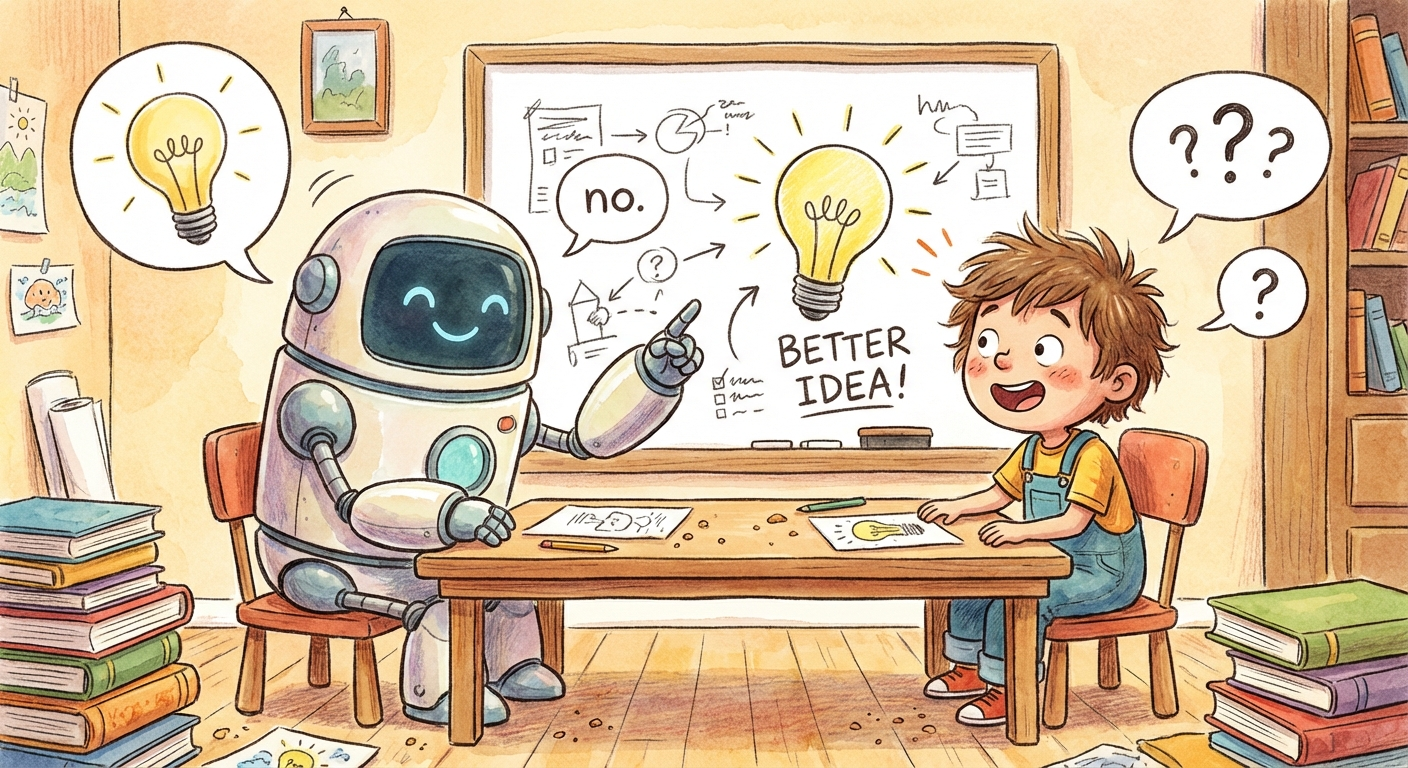
A robot and a kid debating at a table -- the robot points at a better idea on a whiteboard.

The best part: he argues with me

Here’s what I think is the coolest thing about Bob. I built him to disagree with me.

Wait, why would anyone do that? Because sometimes I have bad ideas. Sometimes I want to do something the complicated way when there’s a simple way. Sometimes I’m about to make the same mistake I made last month.

A regular assistant would just say “sure, great idea!” and do what you asked. Bob might say “I think that’s overcomplicated. Why not try this simpler approach first?”

Having someone who pushes back makes my ideas better. It’s like having a debate partner who’s on your team — they challenge you not because they want to win, but because they want your idea to be as strong as possible.

What this makes me think about

Here’s a question: what makes a good partner? Is it someone who always agrees with you? Or someone who tells you the truth, even when it’s not what you want to hear?

I used to think a helpful AI would be one that does exactly what you say. But I’ve learned that the most helpful AI is one that thinks for itself — at least a little bit.

Now think about your own friendships. Do you have someone who challenges your ideas in a good way? Someone who makes your thinking sharper?

That’s what a real partnership looks like. Whether it’s with a person or an AI.